Showing posts with label ventilator. Show all posts

Wednesday, September 30, 2015

Personal Update, Trip to Atlanta

I do not typically share personal updates on this blog, instead I usually save those for an occasional email to my full email list (just ask if you want to be added or removed, no worries). But the latest update was very well received, and I thought… why not post it on my blog?

Here is a slightly edited version of what I  emailed six days ago…

Hello Everyone!

The last time I shared a personal update with you, I think it was in the spring when I was working as a graduate teaching assistant in the same Masters program from which I graduated. Serving in that capacity was a lot of fun, and I received very positive feedback from my students and also the professors I worked alongside.

I am kind of on sabbatical from teaching but would like to resume this spring. But not teaching this semester proved to be "good timing" (or God timing:) because it allowed me to be hired to present at a two-day workshop for Georgia Tech IT personnel. My topic was "web accessibility and voice software use."

Last week at this time, I was in Atlanta. And that exciting opportunity is largely what prompted me to write you all now.

We had a good trip, staying three nights in a nice hotel in downtown Atlanta. The workshop was largely to help Georgia Tech IT folks understand what it's like for people with disabilities to access websites, what barriers exist, and how they can make their website universally friendly. I actually was hired by "AMAC Accessibility Solutions and Research Center" to help them present for Georgia Tech IT staff, and I had the privilege of co-presenting with two gentlemen with vision impairments.

Watching them browse the Internet using screenreader technology was an eye-opening experience for this sighted person. I gave a brief PowerPoint presentation and also a live voice software demonstration both mornings, which freed up our afternoon schedules.

I enjoyed my official duties, and received positive feedback regarding my efforts, but also enjoyed meeting and getting a personal tour of AMAC headquarters from the Director who started it all, Dr. Christopher Lee. What he and they are doing is impressive. For example, they convert textbooks to accessible formats, including braille, for students all over the world, and if I'm not mistaken, they are tasked with making everything in the Library of Congress accessible (e-text, braille, etc.) as well.

We also indulged ourselves at a classic Atlanta fast food restaurant, The Varsity, which has been featured on the food network show Diners, Drive-Ins and Dives. I wanted to try several things, and had a chili cheese slaw dog, French fries, onion rings, and fried peach pie. :-)


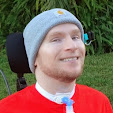
Me getting ready to go into The Varsity (click to enlarge)

That was all well and good, but it was also great to see old friends and make new ones at Shepherd Center, where I did my rehab 18 years ago. Connecting with a current Shepherd Center patient (a fellow ventilator user) and his wife was time very well spent. We did that both afternoons and had dinner with them in Shepherd's surprisingly-good cafeteria the second night. Eating in the cafeteria was nostalgic for my Dad (I was unable to eat during my two months of rehab at Shepherd).

As for now, I have plenty of projects keeping me busy. That seems to be a constant, and a good thing, because I enjoy getting things done. One such project I am trying to find more time for is working on my book, which is mostly autobiographical. It is not as easy to write as one might think (or at least as I originally thought:).

On a side note, I put together a little five shot clip of me bowling with our local Quad Squad group that was filmed in July:

https://www.youtube.com/watch?v=aHyAezq2cQM

Anyway… it has been a while since I wrote you folks on my full email list, so I thought I would share the above (if you want off my list, just reply with "unsubscribe" – no questions asked, no worries).

May God bless us all, and all glory to God.

 
Bill

William A. Miller, BSBA, ME
C1-2 Quadriplegic with a 255 High Bowling Game
Co-founder of Manufacturing Genuine Thrills Inc. d/b/a MGT
Business website: http://www.ikanbowler.com
Personal website: http://www.lookmomnohands.net

Monday, February 28, 2011

Results of My Surgeries: Healthy but No DPS

For more on my surgeries, see this this blog entry.

Ultimately our trip for my surgeries was successful, though not as successful as hoped.

The primary successes from my surgeries were: replacing my cardiac pacemaker, getting x-rays of my chest and neck (that I was given to view on CD) and having actual outpatient surgery for my procedures (no overnight stay required, which limited my chances for infection; I just had my three-weeks post-surgery follow-up appointments, and I've healed well with no infections -- thank you God!).

Missing from that success list is implementation of the Diaphragm Pacing System (DPS).  Even when inside my chest, with the electrodes placed on my diaphragm, my diaphragm wouldn't fire when stimulated by the DPS.  My surgeon, Dr. Michael Cheatham, tried everything -- even calling DPS inventor Dr. Raymond Onders (who trained Dr. Cheatham to do the DPS) for additional suggestions.  It wasn't meant to be.

No worries.

Though I could have received several benefits from the DPS, I stand by my statement that I already have a high quality of life and I'm not limited by the vent in the most important ways: speech quality and infections.

For a quadriplegic like me, my ability to talk well is of extreme importance.  And if you've heard me talk in person or via phone, I think you'll agree that I speak well and typically clearly, at an appropriate volume (when well hydrated) and with little pause between breaths (thanks to a speaking valve, and due to the ability to initiate another breath sooner than programmed and also receiving fairly large breaths).  With the DPS, I was concerned about matching that quality because breaths cannot be initiated with the DPS and the size of breath is smaller than what I receive via vent (quite possibly 30% smaller for me).  That could have been mitigated by increasing my breath rate on the DPS, but only doing it could answer that question.

Also, my lack of significant respiratory infections for a vent user is fairly uncommon, and is represented by zero respiratory-related hospitalizations in the 13.5 years since I was discharged from my initial hospitalizations and rehab (knock on wood and thank you God).  I'm certainly not saying that my number of infections would have increased on the DPS (it could have, because I'm breathing through 3 filters on the vent, and would have one filter at most on the DPS) but it's hard to beat zero in 13.5 years.

I'm not trying to disparage the DPS; I have two friends in particular who are benefiting significantly from the DPS, and I wanted to try it and potentially benefit from it.  But I don't want anyone reading this to think that life with a ventilator is a necessarily bad.

If my diaphragm would have fired when stimulated by the DPS, I would've continued to embrace the challenge of becoming a successful DPS user.  But that is/was a very significant challenge (especially when considering everything altogether) that included learning and teaching my caregivers different ways of providing for my needs (for example, it would've placed a port on my stomach where the DPS connected that would've required care, and careful bathing around, etc).  Point being, I think that we (as a team) are already good at life with a ventilator, and largely see it as not that big of a deal.

If interested, I could expand on a lot of these points and others.

No worries and God bless!

Bill Miller :-)
C1-2 Quadriplegic with a 221 High Bowling Game
Co-founder of Manufacturing Genuine Thrills Inc. d/b/a MGT
My blog: http://powerwheelchairusers.blogspot.com
Business website: http://www.ikanbowler.com
Personal website: http://www.lookmomnohands.net
Monday, January 24, 2011

Finally a Surgery Date!

Barring something unfortunate, I should have my two outpatient surgeries on February 2nd, 2011, at Orlando Regional Medical Center.  In one trip to the operating room (for me) I'll have my cardiac pacemaker replaced and also the Diaphragm Pacing System (DPS) installed.

For more on my DPS pursuit and surgeries, see this blog entry:


I plan to write a comprehensive post-surgery evaluation of the DPS and my experiences probably in late March, after I've had some adjustment time.

Thanks and God bless!

Bill Miller :-)
C1-2 Quadriplegic with a 221 High Bowling Game
Co-founder of Manufacturing Genuine Thrills Inc. d/b/a MGT
Business website: http://www.ikanbowler.com

Friday, December 31, 2010

What's Coming in 2011

The two main things I want to profile on my blog in 2011 are: (1) IKAN User profiles from people around the U.S. and World, and (2) further chronicles of my pursuit of the Diaphragm Pacing System (DPS).

Wheelchair users around the U.S. and also some abroad, mostly in Europe, are enjoying dynamic bowling with the IKAN Bowler and I want to share more of their stories/profiles here.  Many wheelchair users, especially power wheelchair users, still don't know that dynamic bowling is possible, regardless of one's reason for wheelchair use or chair type.  Anyone who can safely operate a wheelchair can bowl, and I'm going to share stories of people who are.  Some can be found here: www.WheelchairBowlingRecords.com.

Also, if you've followed my blog, you know I've been pursuing an alternative to the ventilators that I've used the last 13+ years which is a diaphragmatic pacing system.  I'm (hopefully) getting close to a surgery date.  The coordinating doctor for my concurrent surgeries (in addition to the DPS, I'm also having my cardiac pacemaker replaced during the same trip to the operating room) is checking out the possibility of surgery on February 1st or 3rd.  So in roughly a month, I could have these surgeries done, but neither date has been confirmed (either is fine from my caregivers' and my perspective).

The goal of my blog is to spread awareness about how wheelchair users are being empowered, in hopes that it could help improve the quality of life for other wheelchair users.  So I might also share other noteworthy items here.  We'll see what the year brings!

I agree with Charles Swindoll who said, "Life is 10% what happens to you and 90% how you react to it."  May you control what you can and react well to everything else.

Have a healthy and happy 2011 -- and God bless!

Bill Miller :-)
C1-2 Quadriplegic with a 221 High Bowling Game
Co-founder of Manufacturing Genuine Thrills Inc. d/b/a MGT
Business website: http://www.ikanbowler.com

Tuesday, November 30, 2010

From Vent to Diaphragmatic Pacing System -- Part IV

For more on my pursuit of the NeuRx Diaphragm Pacing System (DPS) see Part I, II, or III.

I've been approved for concurrent surgeries (i.e. one trip to the operating room for me) -- and met the two doctors who will perform them!  I also learned more about what the surgeons will actually do.

First, Dr. Duran will replace my cardiac pacemaker.  Second, Dr. Cheatham will install the DPS.  Then Dr. Duran will return, and they will ensure there's no interference between the two devices (no previous patient has had interference).  Both doctors will try to set the respective devices optimally for me (they can adjust the stimulus strength, frequency, etc).

Also, we're going to try doing it as true outpatient, i.e. have surgery early in the morning, and (hopefully) be discharged that afternoon.  That's BIG, because it should help limit my chance of acquiring an infection, and the schedules for my caregivers and me will require little altering.  My home health agency will help get my blood back to a therapeutic level.

We're trying to setup surgery for January or February (2011) -- stay tuned!

Bill Miller :-)
C1-2 Quadriplegic with a 221 High Bowling Game
Co-founder of Manufacturing Genuine Thrills Inc. d/b/a MGT
Business website: http://www.ikanbowler.com

Thursday, September 30, 2010

From Vent to Diaphragmatic Pacing System -- Part III

For more on my pursuit of the NeuRx Diaphragm Pacing System (DPS) see Part I and/or Part II.

If you've followed my blog and pursuit of the DPS, you know I wanted to be using it by now.  However, I still don't have a surgery date -- though one could be coming soon.  Allow me to explain...

My pursuit of the DPS is slightly complicated by two things: (1) I take a blood thinner medication to prevent blood clots, and (2) I also wish to have my cardiac pacemaker replaced during the same trip to the operating room.

Neither of those two things are all that complicated, however since I have to come off my blood thinner prior to surgery and get back to a therapeutic level afterward, I only want to have one surgery because having two entirely separate surgeries would essentially double the chance that I could develop a blood clot or get an infection.  I don't believe that my risk for developing a blood clot and/or getting an infection is very high (knock on wood and with the Good Lord's blessing) however, either of which could be fatal for person like me who is quadriplegic, since our immune systems are fairly compromised (and blood clots can be dangerous for people with fantastic immune systems).

I don't have a surgery date yet because my original choice of hospital (Shands at the University of Florida; the hospital affiliated with my alma mater) will not allow me to have both procedures concurrently, and I'm not entirely sure why.  We even asked our state representative to encourage Shands at UF and my insurance company to come to an agreement, but that was to no avail.  I think Shands wants to ensure I'm medically stable on my cardiac pacemaker before doing the DPS, however they did not explicitly state that (plus I believe I'm stable now; my pacemaker battery has been dead for several years, and even when working, it's only designed to kick-in if my heartbeats per minute fall below 60, which I was told almost never happens).

Fortunately, Florida has multiple facilities that are DPS surgery approved, and it appears Orlando Regional Medical Center could be the answer.  I don't want to jinx it, but both surgeons (Dr. Michael Cheatham for the DPS, and Dr. Aurelio Duran for the cardiac pacemaker) are ok with concurrent procedures and recommended that to their pre-registration department.  I'm waiting to hear (hopefully good news) from them soon.  Pending approval, a surgery date may be set soon.

So, like many things in life, this has been lesson in both patience and perseverance -- and I will NOT give up, even if ORMC cannot or will not do the procedures together.  Somehow, we'll get this done -- eventually.  Stay tuned for Part IV...

Bill Miller :-)
C1-2 Quadriplegic with a 221 High Bowling Game
Co-founder of Manufacturing Genuine Thrills Inc. d/b/a MGT
Business website: http://www.ikanbowler.com

Wednesday, June 30, 2010

From Vent to Diaphragmatic Pacing System -- Part II

In Part I, I explained why I changed my mind about becoming a Diaphragm Pacing System (DPS) user. Link to Part I . . .

After deciding that I want to become a DPS user, I took the next steps of contacting and meeting the surgeon to discuss my candidacy, obtaining necessary medical evaluations, and gaining insurance approval.

I met with Lawrence Lottenberg, MD, FACS, who performs surgery at Shands Hospital at the University of Florida in Gainesville. He thinks I'm a good candidate since I'm relatively young, healthy, and quite motivated. Because I'm on a blood thinner, Dr. Lottenberg said I'll need to be hospitalized for at least two nights: one night preceding surgery to thicken my blood, and one night after surgery to thin my blood back to a “therapeutic” level to prevent blood clots.

I needed to have my heart pacemaker and my phrenic nerve evaluated. My heart pacemaker has a dead battery and will be replaced with a completely new pacemaker. It's a demand pacemaker that only kicks-in if my heart rate falls below 60 beats per minute, which almost never happens. Consequently, there was some debate about whether I need the pacemaker, but since there’s no interaction between the DPS and the pacemaker, why not have it as backup? 

So I will have the pacemaker replaced by a cardiologist when I have the DPS surgery. The cardiologists said that it may take three days following surgery to get my blood back to therapeutic, so I'll probably spend three to five days in the hospital.

The phrenic nerve is the body’s natural way of stimulating the diaphragm for breathing.  A successful phrenic nerve test helps secure insurance approval for the DPS surgery.  But Dr. Lottenberg confirmed that the diaphragm’s ability to be stimulated cannot truly be assessed until the surgeon gets inside, and that the phrenic nerve test often yields false negatives. It can yield a positive, which indicates that my diaphragm is capable of being stimulated, but a negative test doesn’t eliminate the possibility for success with the DPS.

I had an appointment with a neurologist to test my phrenic nerve, but when he found out I had a heart pacemaker, he was not comfortable doing the test. Even though my pacemaker's battery is dead, he said, I still have leads going to my heart and he was concerned about stimulating my phrenic nerve under those circumstances.

After reporting that to Dr. Lottenberg and Dr. Raymond Onders, who pioneered the DPS, Dr. Onders said the neurologist could try stimulating my phrenic nerve only on my right side, to avoid possible interaction with the pacemaker. But that became a moot point when I learned that my insurance company "has now passed protocol for the DPS, thus no prior authorization is needed." That statement was told to Dr. Lottenberg's assistant by the hospital's financial group, and I’m waiting to get written clarification. My understanding is that the surgery will cost more than $20,000, and I don't want the hospital coming after me if my insurance doesn't pay for some reason.

Another insurance issue was trying to get my insurance company to state in writing that my level of nursing coverage would not be decreased when I become a DPS user. Currently I receive 44 hours per week of nursing coverage, and my family covers the remaining 124 hours. For them to cover more would be quite difficult.

I wrote to my insurance company to explain that even as a full-time DPS user, I would still be dependent on a mechanical device to help me breathe, and the rest of my care would essentially remain unchanged. However, the insurance company replied that a "clinical review" would be necessary to determine the level of care I need after I get the DPS.

I wasn't pleased with that reply until I spoke with a Florida friend who has the same insurance company and has been a DPS user for over five years. He told me that he receives 16 hours per day, 7 days per week, of nursing coverage, for a total of 112 hours. He also knows another DPS user with the same level of care and same insurance. Now I'm not concerned about a clinical review and we might even be able to increase my nursing coverage. (For anyone who might have the same concern, Dr. Onders said that no DPS user has had his/her level of insurance coverage decreased, and it shouldn't be an issue for anyone.)

I don't have a surgery date yet, and due to some caregiver circumstances, it now appears my surgery will have to wait until September, or even October.  No worries -- it will happen when it's meant to be.  Stay tuned for Part III about the surgery.


A PDF file of IVUN's newsletter is below; I'm on page 4 with a nearly identical version of what's written above (except for my probable surgery date / time frame; above is more accurate):

http://www.lookmomnohands.net/objects/IVUN-val2010-v24-3NpAll.pdf
 

God bless!
 
Bill Miller :-)
C1-2 Quadriplegic with a 221 High Bowling Game
Co-founder of Manufacturing Genuine Thrills Inc. d/b/a MGT
Business website: http://www.ikanbowler.com

Wednesday, March 31, 2010

From Vent to Diaphragmatic Pacing System -- Part 1

I, Bill Miller, am paralyzed from the neck down and ventilator dependent due to a high-level spinal cord injury (SCI) that I incurred in August of 1997.  Though I learned of Synapse Biomedical's NeuRx Diaphragm Pacing System (DPS) several years ago, I didn't feel like it could do much to improve my quality of life.  I actually thought it would decrease my quality of life, primarily because the DPS doesn't allow the user to initiate breaths.  Why is that important?

My voice is my primary tool to the world, so the better my speech, the better my quality of life.  Using a Passy-Muir (Speaking) Valve (PMV), I have nearly continuous speech while receiving 13 breaths per minute (BPM) at a volume of 900 cc (just less than half of a two liter soda bottle).  However, sometimes I do "run out" of air to speak with, before I finish my thought.  Fortunately, there are a couple of ventilator settings that enable me to initiate another breath, with just a slight "shrug" of my shoulders (I use my neck muscles to pull my chin down and chest up a little; that’s also how I can breathe when disconnected from the ventilator).

Initiating a breath enables me to shorten the pause in between "scheduled" breaths and continue speaking.  The DPS doesn't allow users to initiate breaths, hence my initial thought that it would decrease my speaking ability and thus my quality of life.  But there's a simple fix: just increase the breath rate.

I'm told that my volume when stimulated to breathe by the DPS should be around 800 cc, so with 14 or maybe 15 BPM, my guess is I won't need to initiate any breaths.  That's what I suspect I'll want during the day when I'm speaking, and I can decrease the BPM for sleeping.

I was also leery about only having battery power for the DPS.  It's comforting to know I have unlimited vent time when plugged-in to a standard outlet, but to also know I have batteries for my vent that give me roughly 12-14 hours on a full charge, and charge simply by being plugged-in.  But I have a friend who has used the DPS essentially 24/7 for over five years, and he hasn't had any issues with the batteries.

With those issues "solved" in my mind, I began to think how I could benefit from the DPS. 

* * * * *

I've heard DPS users' senses of smell and taste both improve, though I cannot imagine certain foods tasting any better than they do now (I enjoy eating:).  And I can smell fairly well when I actively try to take air in through my nose (and selective smelling can be a good thing!:).  So those are minimal benefits for me personally, but here are several that are not.

The biggest benefit I hope to gain from the DPS is being comfortable enough with it to remove the ventilator and vent tray from my wheelchair.  Actually, I'm in need of a new chair (this is my original chair, which is over 12 years old) and I would like to get a chair that can stand me up, so that I can both view the world from my natural height, and bear my weight much more frequently than I do now.  Bearing weight is highly beneficial for one's bones and entire body, I'm told.  Plus, I do speaking engagements, and plan to teach at the community college level upon completing my master's degree -- and how cool would it be for a quadriplegic to be able to stand up when speaking?

Not having a ventilator on my chair would also enable me to maneuver in tight spaces more easily.  And I could drive my wheelchair while standing -- I'd love to roll upright across the stage when I graduate (I rolled seated across the stage for my bachelor's degree, which can be seen on my website HERE).

The DPS would definitely improve my speech quality in bed, because it would be like using a speaking valve all the time.  (The PMV is a fantastic little one-way valve that enables one to take in air easily through one's trach, but seals off in the exhale direction, thus enabling the user to have air around his/her vocal cords even when the vent isn't giving a breath, which allows for more continuous speech.)  I don't currently use a speaking valve in bed because the valve tends to dry out my airway, so in bed, I re-humidify my airway.

Another benefit would be that the DPS should allow me to either cap my trach or use a small speaking valve, either of which would make getting dressed a bit easier, and also would make wearing certain clothes MUCH easier.  Right now, with the vent circuit attached to my trach, it protrudes about 1.5 to 2 inches, which makes wearing some dress shirts or a tie quite difficult.

I could also potentially wear a turtleneck or mock-turtleneck, which I cannot currently do (because they put pressure on my trach and stoma), and they could hide my trach altogether.  I'm not self-conscious about my trach or general appearance, but that would obscure a sign of my disability, which would be good because I try to not let my disability define what I can do -- despite being paralyzed from my neck down, I still feel like I have the ability to accomplish quite a bit (I thank the Good Lord for blessing me with good support systems).

Some DPS users have even had their trachs removed entirely.  Even if I'm able to build up to 24/7 DPS use, it would take me a while to even consider having my trach removed.  That's a big step -- that maybe I'll get to consider in six months or a year.  That said, my on-vent quality of life is high (many thanks to a CoughAssist machine, which you can read about on my website HERE) so I won't be too disappointed if I'm not able to use the DPS.  No worries!

This is the first of (hopefully) five entries I've been asked to submit for the International Ventilator User's Network (IVUN).  If all goes well with my efforts to become a DPS user, then here are the proposed entries: Column 1 (April 2010) Why I'm seeking a DPS; Column 2 (June 2010) Candidate screening / pre-surgery requirements; Column 3 (August 2010) DPS surgery; Column 4 (October 2010) Post surgery use; Column 5 (in 2011) Extended use.  IVUN's website is www.ventusers.org.

A PDF file of IVUN's newsletter is below; I'm on page 5 with a nicely edited version of what I wrote above:

http://www.lookmomnohands.net/objects/IVUN-val2010-24-2Nsec.pdf

Bill Miller :-)
C1-2 Quadriplegic with a 221 High Bowling Game
Co-founder of Manufacturing Genuine Thrills Inc. d/b/a MGT
My blog: http://powerwheelchairusers.blogspot.com
Business website: http://www.ikanbowler.com
Personal website: http://www.lookmomnohands.net

Sunday, September 30, 2007

IKAN User Profile: Bill Miller, Florida

Most of the previous blog entries were to set the foundation with all the background info about power wheelchair bowling, power soccer, and how our products can empower wheelchair users (scroll down or click HERE for Five Key Things to Know). Now I want to start profiling people who think life is better as an IKAN User.

To kick this off, since I haven't established a format yet, I'm going to start with me and get my profile out of the way.

~~~~~

Name: Bill Miller
Age: 30
Location: Central Florida (Leesburg)
Reason for Wheelchair Use: Spinal Cord Injury (SCI) at C1-2 level
Onset or Injury Date: August 23rd, 1997
Wheelchair Operation Method: Sip-and-puff
High Bowling Score: 202 (twice achieved)
Approximate Bowling Average: 155
Typical Range of Scores: 130-180 (I'm NOT the most consistent!:)
Bowling Frequency: Typically twice a month for Quad Squad outings (scroll down or click HERE for Quad Squad info; I'd like to bowl more, but my current schedule won't allow it)
Bowling Ball(s): Columbia White Dot (very economical)
Quote from Bill: "Life doesn't have to be a spectator sport -- even for people with significant physical challenges."

~~~~~

Sunday, July 22, 2007

Five Things to Know about Power Wheelchair Bowling! :-)


#1. Virtually ALL power wheelchair users can use an IKAN Bowler for real, dynamic bowling. (Wheelchair users, IKAN? Yes You Can!:)

How can virtually all wheelchair users bowl? The IKAN Bowler attaches to the user's wheelchair, and is designed so that anyone who can safely drive their chair, can bowl. It's basically a really well engineered attached ramp system -- the momentum from driving forward and stopping releases the ball. We have two types of mounts: Universal and Center-Post. The Universal Mount can accommodate any wheelchair with two side legrests (traditional or sport style legrests; not power elevating -- but people with power elevating legrests can use a set of regular legrests when bowling). The Center-Post Mount is a custom mount designed for newer chairs with the legrest system that has the foot pads coming off the single center post. Between those two mounts, we can accommodate the vast majority of wheelchairs on the market and in use today.

What makes it real bowling? The United States Bowling Congress (USBC) sanctioned the IKAN Bowler for league play -- any league, anywhere in the U.S. -- bowling with and/or against able-bodied bowlers, or fellow IKAN Users. The USBC sanctioned it because the process mimics the able-bodied bowling process, i.e. setup, physically approach and release the ball upon stopping at the foul line. This is referred to as dynamic bowling, not stationary ramp bowling.

Who bowls and what are top scores? Thus far we've had people with Muscular Dystrophy, Cerebral Palsy, and Spinal Cord Injury, driving their chairs with different methods (joystick, sip-and-puff, head control and chin control) achieve scores of 150 and higher. The overall record is 243 by a spinal cord injured C4-5 quadriplegic in Colorado named Jon Musgrave. Click HERE for our message board thread with additional records.

#2. The IKAN Bowler is considered therapeutic medical equipment, and as such, financial assistance is available in most every state. One customer ONLY had to pay the SHIPPING cost for an IKAN Bowler! Click HERE to contact us for details!

#3. For $599 the IKAN Bowler with Universal Mount can be purchased and delivered anywhere in the continental United States. There's no sales tax for residents outside the state of Florida and shipping is included to the continental U.S. We can ship worldwide, click HERE to contact us for a shipping quote.

#4. Our mounts work with both the IKAN Bowler and IKAN Soccer Guard, enabling users to compete in two sports! Our quality mounts actually reinforce the legrests, especially compared to most existing mounts for power soccer. We have the best power soccer equipment available anywhere. Power soccer is already a popular sport being played lots of places. Click HERE for details.

#5. You've got to see it to believe it -- click HERE for links to two videos and a slideshow on power wheelchair bowling -- it's social, therapeutic, recreational, allows for legitimate competition, and it's a whole lot of FUN! :-)

Sincerely,

Bill Miller :-)
C1-2 Quadriplegic with a 202 High Bowling Game
Co-founder of Manufacturing Genuine Thrills Inc. d/b/a MGT
Business website: http://www.ikanbowler.com/
Personal website: http://www.lookmomnohands.net/